Borrowed Cadence: What My Grandmother's Kitchen Taught Me About the Line Break
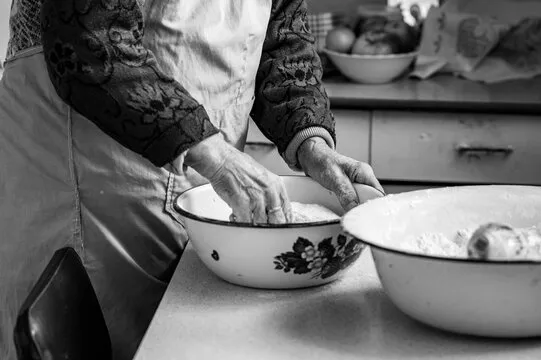
Photo: vintage southern kitchen grandmother cooking black and white photograph, via t4.ftcdn.net
The First Music
Every poet has a first music, and mine was not on any record player. It came from a woman named Lucille, my grandmother, who stood about five feet tall in her house shoes and narrated the entire day as though the day were a serial drama she'd been following for decades. Well, I never did trust that icebox. He'd sooner argue than eat. Don't go borrowing trouble; trouble knows where you live.
I didn't know I was taking notes. That is the point of inheritance: nobody hands you the receipt.
Years later, when I began writing poems seriously, I noticed something odd in my drafts. My line breaks had a certain domestic gait. They turned on small objects, on conditional statements, on a rhythm of complaint and affection braided together. When I finally slowed down enough to look, I found Lucille waiting in nearly every stanza.
Line Breaks as Family Habits
Consider what a line break does. It makes a small promise, then pauses. It lets the reader lean forward. My grandmother did this constantly, only she used a fork or a dish towel instead of a stanza. She would begin a story about a neighbor's divorce, stop to drain the okra, and hold the whole room hostage until the pot was covered. The pause was never empty. It was load-bearing.
When I look at my published work now, I can see that I break lines the way she broke sentences, at the moment of maximum domestic tension. A line of mine ends, in one poem, on the word enough. In the draft it didn't. The break moved there only after I heard, one afternoon, her voice in my own head saying that's enough of that to a boiling pot. The line wanted her cadence, and I let it have one.
The Audit of Overheard Speech
I want to propose an exercise, one I now assign myself every few years. Take three or four of your finished poems and read them aloud. Then read them again, slowly, and mark every phrase that makes you flinch with recognition, every turn of speech that feels less like composition and more like memory. Ask: whose voice is this?
In my own audit, I found:
- A poem built on the word fixing, as in fixing supper, which no one in my adult household has ever said. My grandmother said it nightly.
- A repeated structure of rhetorical questions, and what was I supposed to do with that?, which is her exact method of ending an argument she was winning.
- An almost embarrassing fondness for the conditional would, the grammar of the hypothetical that governed every story she told about people who died before I was born.
None of this was chosen. All of it was chosen, somewhere, by someone else, and handed to me like a cast-iron skillet.
Regional Rhythm and the Formal Poem
There is a worry among some writing students that inherited speech will make a poem too casual, too regional, too much of one place. I want to argue the opposite. The formal poem, the one with its careful meter and its literary diction, is the borrowed object; the voice is what you actually own.
When I write in received forms, I find that my grandmother's rhythms keep the poem honest. A sonnet that sounds like nobody is a dead sonnet. A sonnet that occasionally sounds like a woman in a kitchen in Mississippi telling you that trouble knows where you live, that sonnet has a pulse.
This is not to say we should transcribe our relatives. Transcription is not craft. The work is in the selection, the pressure, the willingness to let a family cadence carry weight it never carried before. Lucille never said anything about grief, but she said don't go borrowing trouble in a way that, placed at the end of a poem about my father's illness, does work she never intended and could not have imagined.
Gratitude and the Unchosen Voice
I have come to think of my reading voice, the voice I use at podiums and in classrooms, as partly hers. Not the accent, exactly, which has softened over decades of living elsewhere. The pacing. The habit of pausing before the thing that matters. The instinct to make the audience lean in by simply stopping.
If you are a young poet wondering where your voice is, consider that it may not be in you at all. It may be in the kitchen, in the front seat of a Buick, on a porch in a town you left at eighteen. Go back and listen. Then come home and break your lines where they broke their sentences.
The inheritance is real. The only question is whether you will sign for it.