Hum and Whirr: Notes on the Coin-Operated Muse
The Four Seconds After the Card Is Swallowed
There is a particular silence that follows the transaction. The card goes in, the machine thinks, and for four or five seconds you are nobody's customer, nobody's student, nobody's returning phone call. You are just a person standing in fluorescent light, waiting for permission to leave. I have come to believe those four seconds are among the most poetically productive real estate in America.
I drafted the ending of a poem about my father while a vending machine in a rest stop outside Amarillo deliberated over whether my dollar bill was counterfeit. The poem had stalled for weeks at home, in my actual writing room, with its good lamp and its intention. But there, with the hum of refrigeration behind me and a highway humming beyond the glass, the last two lines arrived whole. I wrote them on a receipt for a honey bun.
Liminal by Design
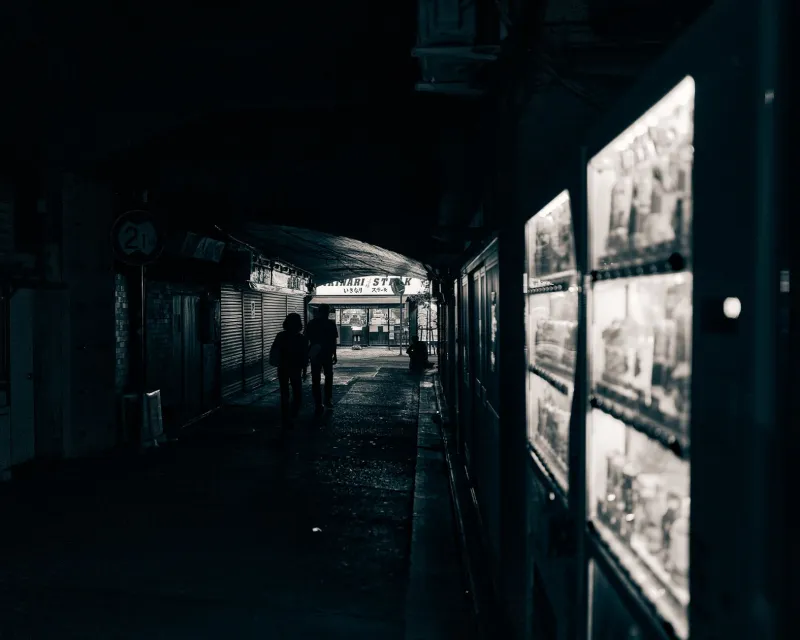
We tend to imagine the writer's workspace as a room: desk, window, perhaps a cat. But American automation has quietly built an alternate architecture of solitude. The ATM alcove. The self-checkout kiosk with its recorded voice—unexpected item in bagging area—that speaks to no one and everyone. The airport ticket kiosk. The Redbox glowing outside a grocery store at eleven at night.
These spaces share a peculiar quality: they demand your full attention while asking nothing of your inner life. You must be present—watch the screen, confirm the transaction, retrieve your cash—but the machine does not care what you think about while you do it. That gap between attention and imagination is exactly where poems start. It is the modern equivalent of rocking a butter churn or driving a plow: hands busy, mind loose.
The Unlyric Made Lyric
There is a long tradition of poets romanticizing the pastoral—the field, the orchard, the sea. But most Americans now spend their waiting hours beside machines, not meadows. I would rather argue for the world we actually inhabit. The ATM vestibule is a room of one's own, rented by the minute. Its vocabulary is strangely rich, too: insert, withdraw, declined, available balance. Say those words aloud in a poem and watch how they bristle against the lyric.
And the machines themselves are natural sonnet-makers—small sealed boxes that dispense exactly what was promised, no more. Is that not the ideal of the well-made poem? Fourteen lines, each one paid for, nothing jammed in the mechanism.
A Defense of Wasted Time
I understand the objection: shouldn't we resist the automation of everything, including attention? Yes—and I do resist it, mostly. But I have also stopped pretending that inspiration respects the calendar block I set aside for it. The muse, in my experience, is less a dove than a coin-operated dispenser herself: she appears when the conditions are right, and the conditions are usually boredom, fluorescent light, and a low mechanical hum.
So here is my small proposal for fellow writers. The next time you are trapped in a transactional nowhere—waiting for the kiosk, the pump, the machine to count your change—do not reach for your phone. Reach for a receipt, a pencil stub, the back of a parking stub. Let the machine hum. Let the mind wander its aisle.
The poem I finished in Amarillo is in my second book now. The honey bun receipt is in a drawer. Both feel, to me, like evidence of the same fact: poetry does not require a beautiful room. It requires a human being briefly alone with her own noise, standing beside something that only pretends to think.