The Room Has a Request: Occasional Poems and the Discipline of Address
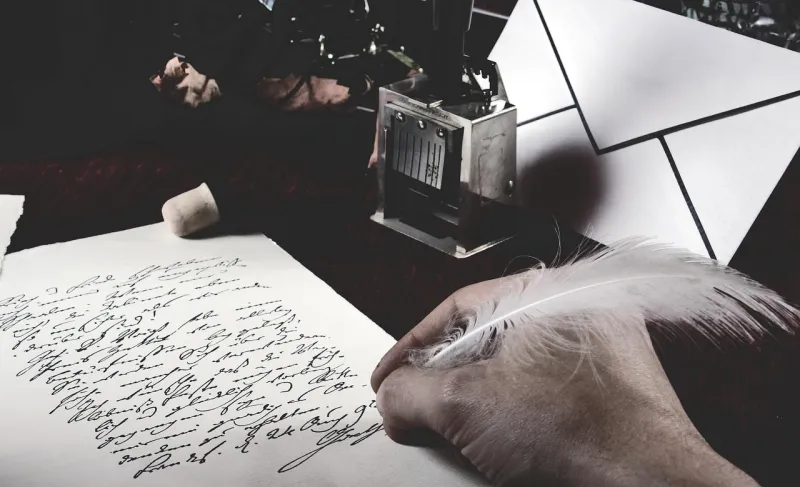
Photo: poet writing occasion poem at wooden desk with wedding invitation, notebook, and pen, natural light, via cdn.pixabay.com
The Request Arrives
“Someone’s getting married,” the message begins, and I know before I finish reading that a question is coming. The requests rarely arrive as formal commissions. They surface after a reading, in the pause beside a coffee urn, or in an email whose subject line is simply my name. A cousin is retiring. A neighbor’s father has died. A couple who heard me read three years ago would like a poem for their ceremony. The occasion is already underway; the poem is asked to enter a room that has been planned for months.
Over the past decade I have written occasional poems for weddings, anniversaries, retirements, and funerals. I have learned that the occasional poem is not a lesser form. It is a craft problem with a guest list. The room has a request, and the poet’s task is to answer it without abandoning the discipline that makes a poem worth hearing in the first place.
What Gets Negotiated
The negotiation begins early. Length matters, because a poem read during a ceremony is not the same as a poem read at a reception. Tone matters more. One couple asked for something “warm but not gushing.” A daughter requesting a poem for her father’s retirement asked that I not make the room cry. A family preparing a funeral asked for restraint: they wanted grief acknowledged, not amplified.
Names are a practical matter. So are pronouns, pronunciations, and the question of whether a private reference will mean anything to the assembled guests. I have learned to ask who will be in the room. A poem addressed only to the couple may leave the grandparents adrift; a poem addressed only to the room may forget the two people at its center. The occasional poem must triangulate.
There are also terms. Will the poem be printed, posted, framed, shared online? Who may hear it? I do not publish occasional poems without permission. The occasion is private even when the craft is public. A poem written for a funeral is not mine to circulate because it moved me. It belongs first to the people who asked for it.
Sincerity Without Sentimentality
The pressure of the occasion is the pressure toward abstraction. Weddings invite the language of souls and journeys. Funerals invite the language of angels and better places. Retirements invite the language of legacy and chapters. These phrases are not wrong, exactly; they are simply too general to carry the weight of a particular life.
Sentimentality, as I understand it, is feeling without witness. It tells the audience what to feel rather than showing them the detail that might produce feeling on its own. Sincerity is feeling with witness. It trusts the concrete object: the chipped mug, the borrowed truck, the way a man always checked the locks twice before leaving. The occasional poem needs particulars, not because particulars are decorative, but because they are evidence.
I try to find one image that belongs to the occasion and let it do more work than any declaration. For a wedding, it might be the couple’s habit of splitting a sandwich at the kitchen counter. For a funeral, it might be the deceased’s handwriting on a grocery list. The image is not the whole poem, but it is the door through which the room enters.
The Question of Address
Occasional poems have at least three audiences: the honoree, the gathered room, and the poet. The question of address is therefore not merely technical. It is social. A second-person address to the couple may unintentionally exclude the guests; a first-person poem may become a performance of the poet’s feelings rather than a gift to the occasion. I often draft the poem speaking to the room, then turn slightly toward the honoree in the final lines.
Rhyme is another negotiation. If a family requests it, I do not refuse. Rhyme can be a form of hospitality; it gives the room something to hold. But rhyme must not dictate truth. I prefer slant rhyme, off-rhyme, and internal echoes that allow the sentence to remain honest. A forced rhyme is a small betrayal of the occasion, because it asks the audience to admire the poet at the moment they should be attending to the life being honored.
Borrowing a Life
Every occasional poem borrows someone else’s story. The ethics of that borrowing deserve more attention than they usually receive. I ask permission for details that are not already public. I do not use secrets as material. I do not turn a family’s grief into a poet’s anecdote. When I am unsure, I offer the family a chance to read the poem before the event. Not every poet will want that arrangement, and not every family will need it, but the offer clarifies the relationship: the poem is a gift, not a transaction, and not a claim of ownership.
With writing students, I emphasize that the occasional poem is an exercise in restraint. You are not writing the definitive poem about love, death, or work. You are writing a poem for this room, these people, this afternoon. That limitation is not a compromise. It is the condition of the form.
Notes for Writing Students
Begin with an interview, not a draft. Ask for three concrete details: an object, a habit, a place. Find the one image the poem can stand on. Draft in plain speech before reaching for form. Read the poem aloud at the pace of the room, not the pace of the page. Add rhyme last, if at all, and only where it serves the sentence. Revise for breath, because the poem will be heard before it is read. Deliver a clean copy. Keep one for yourself, with permission.
The occasional poem is often described as a minor form, as if the presence of a cake or a casket disqualifies it from seriousness. I have found the opposite. The room has a request, and the poet must answer with craft, tact, and an accurate ear. The occasion does not lower the standard. It raises the stakes.