The Toughest Room Is the Kitchen Table: Reading Your Poems to the People Who Know You
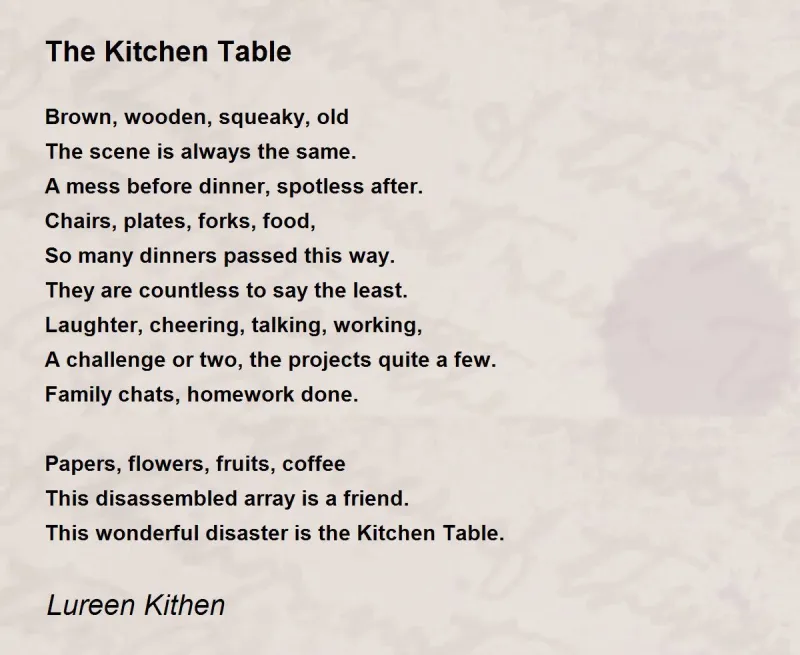
Photo: reading poetry aloud at kitchen table warm home intimate, via www.poemhunter.com
I have read poems to audiences of four hundred strangers without my hands shaking. I have read poems to my mother in her Ohio kitchen and felt my voice go thin as tissue paper. The discrepancy deserves examination, because it turns out the domestic reading — the poem delivered across a kitchen table to someone who has known you for decades — is the most rigorous test a poem can undergo, and the least discussed.
Why the Living Room Is Harder Than the Lectern
A stranger at a reading brings a kind of merciful ignorance. They hear the poem as an object; they evaluate its music, its turn, its ending. Your spouse hears something else entirely: they hear you. They hear the marriage in it, the argument from last March, the grief you mentioned once and never elaborated on. Every abstraction you deployed for safety, they see through in a second.
This is why loved ones are the toughest crowd a poet faces. Strangers judge the poem. Family judges the truth. And a poem that is not entirely true — that flinches, prettifies, or performs — collapses instantly under the gaze of someone who can tell.
Which Poems Survive a Domestic Reading
Over the years, I've noticed a pattern in what works at the kitchen table and what dies there. Poems built on cleverness wither. The people who love you are immune to your charm; they've heard your jokes at breakfast for twenty years. What survives is plainness carried by genuine music. What survives is specificity — the actual name of the actual dog, the real town in Indiana, the dish you actually burned.
There is also the matter of subject. Some poems about family should probably not be read to family, or at least not without warning. I have developed a private taxonomy: poems my mother may hear, poems my husband must hear first, and poems for the public record only. This is not cowardice. It is diplomacy, and diplomacy is part of the writing life whether the workshop acknowledges it or not.
The Silence That Teaches
Here is the practical gift of the domestic audience: they do not applaud to be kind. A stranger claps because clapping is what one does at readings. Your oldest friend, hearing a mediocre stanza, says nothing — or worse, says "hmm" — and that nothing is the most honest editorial feedback in American letters.
I have killed stanzas based solely on the quality of my husband's silence. I have revised endings because my sister, on the phone from Columbus, asked a single devastating question: "But what were you actually trying to say?" The reading-circuit audience never asks this. They nod, they buy the book, they drift away. The people who love you want the poem to mean something, and their wanting is a diagnostic instrument of extraordinary sensitivity.
A Modest Craft for the Kitchen Table
A few practices I've arrived at, offered without ceremony:
Read the poem once, without preamble. Apologies and explanations are a form of insulation, and insulation defeats the purpose.
Watch the face, not the page. A loved one's eyebrows will tell you more than a semester of workshop notes.
Choose the poem for the listener, not the listener for the poem. My father got the poems about work; my mother got the ones about endurance.
And accept the strange gift of being known. It is terrifying to be read by someone who can cross-examine the poem against your life. It is also the only reading where falseness cannot hide.
What the Private Audience Gives Back
The reading circuit teaches you projection, pacing, how to hold a room. The kitchen table teaches you something prior to all that: whether the poem is worth saying, and to whom. Before a poem goes out into the world of strangers, it should be able to survive the eyes of the person who watched you write it.
If it can't, the problem is rarely the listener. The problem is the poem. And that, in the end, is why we keep reading our work across the table — to the spouse drying dishes, the parent squinting at the page, the friend who knew us before we were poets. They are the first readers, the truest audience, and the only ones whose silence we cannot afford to ignore.