A Year in Stacks: Confessions of a Poet Who Cannot Stop Buying Books
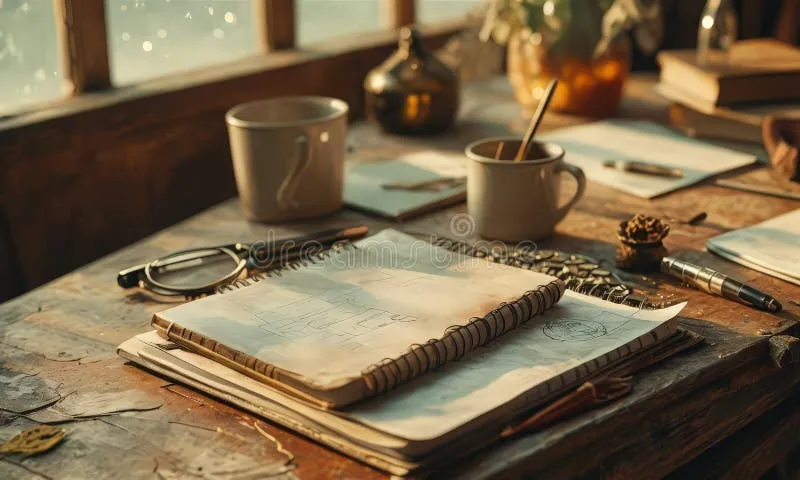
Photo: stack of poetry books on wooden writing desk with notebook and coffee, via thumbs.dreamstime.com
There is a photograph, somewhere in a box in my closet, of the desk I had at twenty-four. It held a laptop, a mug, and exactly three books. I remember feeling enormously proud of this. Look, the desk said, here is a serious writer who owns only what she needs.
The desk in front of me now holds forty-one books. I counted this morning, and I am not proud of that number so much as I am honest about it. Some arrived with purpose; others simply accumulated, the way snow accumulates in Hattiesburg — rarely, and then all at once. What interests me, at the start of another reading year, is how a working poet's stack gets built, and what it means when we ask our reading to do for our writing.
The Intentional Stack and the Accidental One
Every January I make a list of books I intend to read. Every December I realize the list was a fiction. The intentional stack is real — I do seek out new collections for specific reasons. When I was wrestling with a manuscript full of research poems, I pulled down books by poets who could braid fact into lyric without the seams showing. When a review mentioned a debut collection from a poet out of Arkansas whose line breaks made me jealous, I ordered it that afternoon.
But the accidental stack teaches me more. These are the books that arrive sideways: the used copy of a mid-century novel picked up because the cover was beautiful, the poetry collection bought at a reading because the poet was kind to a nervous questioner in the third row, the reread that called to me at midnight because some line I couldn't shake had roots in it somewhere.
I have stopped fighting the accidental stack. It knows things my list does not.
Reading Without Borrowing a Voice
Here is the fear every writing student eventually voices in workshop: if I read too much of poet X while drafting, will I write bad poet X? The worry is legitimate and mostly overblown. Influence is not theft. The trick, I have found, is to read actively rather than absorptively — to read with a pencil, asking how did she do that instead of letting the music pour over you unexamined.
When I finish a collection that staggers me, I try to name the mechanism. Was it the restraint? The turn at the end of each stanza? The willingness to be unlikable on the page? Naming the craft move separates it from the voice. I can steal a technique and make it mine in a way I could never steal a voice. Imitation, when it happens, is usually a sign I haven't yet understood what I was reading — so I go back and read again, slower.
Ten Books Currently on the Desk
A shelf tour, then — the current residents, in no particular order, each with its own job:
- A new collection by a poet friend, pre-publication — read to celebrate, but also to remember that finished books begin as terrified drafts.
- A battered anthology of American poetry from college — its margins contain my twenty-year-old handwriting, which is its own kind of diary.
- A field guide to birds of the Southeast — research, yes, but also a reminder that precision is a form of love.
- A reread of a collection I first loved at twenty-two — it has changed because I have; the reread is a measurement of the distance.
- A book of essays on prosody — dog-eared at the chapter on the sestet, because I am stubborn about sonnets.
- A novel, non-poetic, deliberately — prose teaches poets things poetry cannot: patience, plot, the long middle.
- A chapbook bought for five dollars at a reading in a bookstore that has since closed — a small monument to a small press and an evening that mattered.
- A dictionary I actually open — not the one on my phone; the one with heft, whose pages smell like my grandmother's house.
- A collection I did not like the first time — returned to out of suspicion that the failure was mine.
- A notebook pretending to be a book — where I copy out lines by hand, because transcription is the oldest and best trick for learning a line.
What the Stack Is For
A poet I admire once said that her reading list was her real writing practice, and the poems were just the receipts. I don't go quite that far — the poems matter, the receipts matter — but I take the point. The stack is not decoration. It is the conversation I have chosen to have, year after year, with the dead and the living and the not-yet-published.
The desk will be restacked by spring. Some of these forty-one will return to shelves; new arrivals will claim their territory. That is fine. A reading life, like a garden in Mississippi, is mostly about paying attention to what insists on growing.