Correspondence with the Dead: On Writing Letters That Require No Stamp
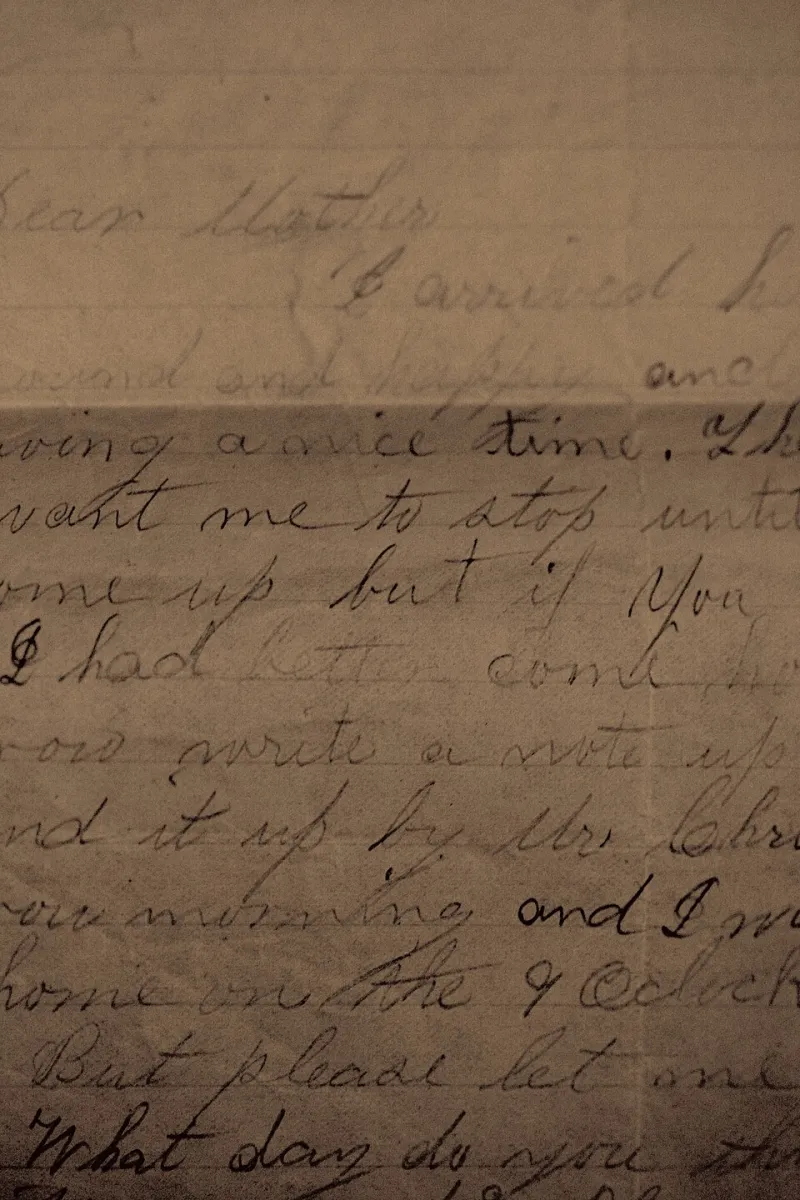
Photo: Pink Sherbet Photography from USA, CC BY 2.0, via Wikimedia Commons
The folder sits in the bottom drawer of my desk, beneath a stack of conference programs and a dead external hard drive I keep for reasons I cannot explain. It is labeled, plainly, Letters—Unsent. Inside are three decades of correspondence with people who never received a word of it: Elizabeth Bishop, James Wright, Lucille Clifton, and a handful of others who drifted in and out of my writing life like weather.
I began the practice in graduate school, though I did not yet have a name for it. I was stuck on a poem, the kind of stuck where every line feels like it was assembled from wet cardboard, and instead of revising I wrote a letter to Bishop. I told her about the poem. I told her about my grandmother's house in Missouri, which the poem was trying and failing to hold. I apologized for presuming to tell her anything at all. Then I wrote a second letter to James Wright, and a third, and by the time the semester ended I had a small epistolary habit that has never fully let go of me.
The Strange Freedom of the Unanswerable Reader
Here is what I discovered, slowly and somewhat against my will: writing to the dead is the most liberating audience work a poet can do.
When we imagine our living readers—a workshop, an editor, the abstract and often hostile "reader" we invoke when a poem isn't working—we imagine judgment. We flinch before the sentence is finished. But Bishop cannot judge me. Clifton will never wince at my sentimentality or circle my clichés in red pen. The dead are the perfect readers precisely because they are unreachable, and that unreachability produces a peculiar candor. I say things in these letters I would never say in a draft note or a craft essay. I confess envy. I ask questions I am embarrassed to ask out loud.
And yet the letters are not slack. They are, strangely, some of the most careful writing I do. Because Bishop is Bishop—because her precision is so exacting that even her grocery lists read like they were machined—I find myself writing with more care than I bring to almost anything else. The imagined reader, even a silent one, disciplines the prose. My letters to Wright have a plainspoken tenderness I rarely achieve elsewhere. My letters to Clifton have a directness that shames my usual hedging.
Influence as Conversation, Not Costume
We tend to talk about influence as though it were a costume the young poet tries on: the Bishop phase, the Levine phase, the unfortunate Yeats phase. But the letters taught me that influence works differently when you treat it as correspondence rather than imitation.
A conversation requires two voices. When I write to Clifton, I am not trying to sound like Clifton; I am trying to say something to her, which means I must find my own register while keeping her attention in mind. That is a fundamentally different exercise from imitation, and I suspect it is a healthier one. The homage happens in the address, not the accent.
Consider an excerpt from a letter I wrote to Wright in the autumn of 2009, after rereading "Lying in a Hammock at William Duffy's Farm in Pine Island, Minnesota" for perhaps the hundredth time:
Jim—I keep teaching your hammock poem and I keep lying to my students about it. I tell them the last line is the whole point, the sudden recognition, and that's true enough, but what I don't tell them is what undoes me: how long the poem waits. The chicken hawk. The cowbells. You make us earn the blessing by making us look at everything first. I am trying to learn patience in my own poems and I am failing at it, and I thought you should know you are at least partly responsible.
I never sent it. Of course I never sent it. But writing it clarified something about my own work—about waiting, about what a poem withholds before it gives—that no workshop conversation had managed.
A Practice for the Skeptical
If this sounds like séance-adjacent sentimentality, I understand the objection. I shared it for years. But the unsent letter is simply a prompt, and a remarkably efficient one. It combines three things writing students are always being told to do: read closely, write regularly, and articulate what you admire.
The method is simple. Choose a poet whose work you know well enough to argue with. Write to them about a specific poem, not their career. Be honest about what you don't understand. Notice, afterward, what the letter revealed about what you want from your own poems. That last step is where the practice pays off: the letter is a mirror with better lighting than a mirror.
Some of my students have kept these letters going for years. One woman in a Mississippi workshop wrote monthly letters to Gwendolyn Brooks for her entire MFA and told me the letters taught her more about rhythm than any seminar. I believe her.
The dead cannot write back. That is the whole point. Their silence is the open space in which we finally hear ourselves—and, if we are lucky, in which a poem begins.