Thirty Seconds of My Voice: What I Learned Reading Poems Into a Phone
Last spring, on a dare from a former student who now works in digital media, I recorded myself reading a short poem — forty-one seconds, start to finish — and posted it to the app my teenagers abandoned years ago. I expected nothing. I expected, if anything, the quiet humiliation of a poet shouting into a current that flows the other direction.
The video did modestly, absurdly well. Not viral — I want to be precise about that — but seen by more people in one evening than have attended every reading I've given in Mississippi combined. And the comments, mostly from strangers under twenty-five, asked a question I have not stopped thinking about since: do you have more of these?
The Length of a Held Breath
The poem I recorded was short because I write short. I have always distrusted the poem that outlasts the reader's patience, a suspicion I inherited from reading Dickinson as a girl in a house where television was rationed like sugar. But the app does not reward brevity so much as it punishes hesitation. The scroll is a guillotine. Anything longer than ninety seconds risks being skipped not because it fails but because it continues.
So I began an experiment. For one season, I posted a reading every Sunday: thirty seconds, sometimes forty-five, always a complete poem, never an excerpt dressed up as one. I set two rules for myself. First, I would not cut poems down to fit the format — if a poem needed four minutes, it stayed in the drawer. Second, I would not read to the camera as if it were a friend. The camera is a room of strangers, and I have spent thirty years learning how to read to strangers.
What the Scroll Gave Back
Here is what surprised me. The audience for these recordings does not behave like a scrolling audience. They rewind. They ask about the line breaks. One commenter transcribed a stanza and asked whether the enjambment in the third line was intentional — a question I would have been delighted to receive at any university reading in the country.
I do not think short-form video is teaching people to want less from poems. I think it is teaching them to want poems they can enter without ceremony. The gatekeeping apparatus of poetry — the journal, the degree, the bookstore poetry section hidden in the back like an embarrassment — never protected the poem. It protected the gatekeepers. A phone camera, pointed at a woman in her fifties reading a poem about her mother's hands, requires no credentials from the viewer. Only attention.
What the Scroll Takes
I will not pretend the losses are small. A poem on a screen is a poem stripped of its body. You cannot feel the white space; you cannot linger on the page the way a page permits lingering. The app measures success in seconds held, and a poet who starts optimizing for seconds held will soon be writing jingles with line breaks. I have watched it happen to better poets than me. The form is a solvent. It dissolves whatever is not already dense.
There is also the matter of the voice. In a room, a poem breathes with the reader; silences are shared property. In a recording, the silence belongs to the algorithm, and the algorithm is ruthless. I learned to read slightly faster than I would at a podium, and I regret every poem I rushed.
Hold the Line, Then Step Over It
My conclusion, offered with the humility of someone still mid-experiment: lean in, but on your own terms. The poets who flourish in short-form video are not the ones who shrink their work to fit; they are the ones who had small, dense, load-bearing poems already, and who now have a delivery system their predecessors never dreamed of. Millay would have been unstoppable on this app. So would Lucille Clifton, whose shortest poems were the heaviest things in any room.
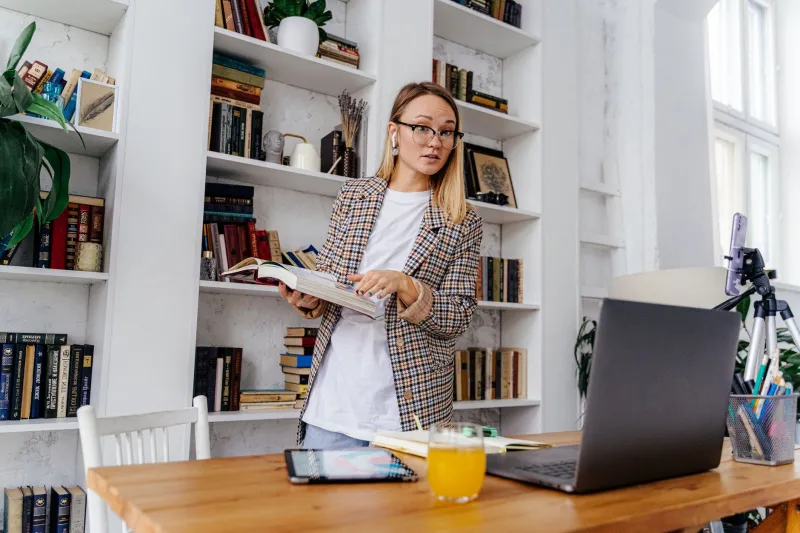
So I continue, most Sundays. I record in the morning when my voice is low, in front of the same bookcase, wearing the same gray sweater, because consistency is its own small argument for seriousness. The poems are not shorter than they were. They were always this length. It turns out the world was simply waiting for a door the width of a phone screen, and some of us had poems small enough to carry through it.