Fifty Dollars and a Glass of Wine: The Honest Ledger of a Poetry Reading
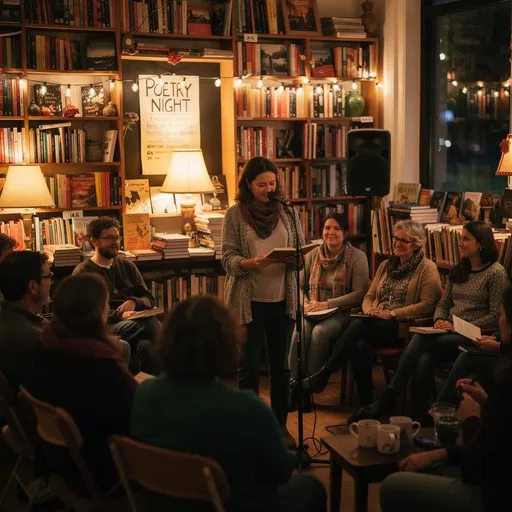
Photo: empty bookstore reading event chairs poet microphone night, via images.stockcake.com
The Receipts I Was Afraid to Add Up
For years I avoided the arithmetic the way one avoids a rejected manuscript: deliberately, with a full knowledge of what waited inside the folder. Then, last January, facing tax season, I opened a spreadsheet and did what no poetry reading had prepared me to do. I counted.
The results covered fourteen readings across eleven states — a university series in Nebraska, a bookstore in Portland, a library basement in rural Ohio, a festival in the Carolinas. The total gross honorariums came to $3,150. The total expenses, including mileage at the IRS rate, two flights, one motel outside Toledo, and a rental car I did not need but could not avoid, came to $1,842. Six hundred and eleven dollars in book sales, of which roughly a third flowed back to the distributor or the venue's cut. Net, before any consideration of my time: just under $1,600. Divided across the hours of travel, waiting, reading, and signing, I earned less per evening than the student who introduced me at the university event makes in a shift at the campus coffee shop.
I say this without bitterness, or at least without only bitterness. I say it because nobody said it to me.
What the Venues Say When They Think No One Is Auditing
I spoke with three people who book poetry events, and their candor surprised me. A series coordinator at a small liberal arts college in the Midwest — she asked that I not use her name, since her budget is renegotiated annually — told me her standard poet honorarium has been $500 for a decade. "It hasn't moved," she said, "because the line item hasn't moved. Poetry is the cheapest excellent thing on our calendar. Nobody fights to raise the poet's fee because poets don't negotiate."
That last sentence should be printed on every MFA orientation packet. Poets, trained in humility and grateful for any platform, historically do not ask. The bookstore events are even starker. A buyer at an independent shop told me that readings there are, in her words, "a service we provide the community and the author provides us." No fee. A glass of wine, occasionally two. Sales split, if the book is on consignment, at a rate that leaves the poet perhaps four dollars a copy.
The free wine honorarium is a real institution. I have been paid in it many times, and I have drunk it in the car afterward while recalculating whether the trip was worth the tank of gas.
The Geography of Getting Paid
The economics are not uniform, and the pattern is worth mapping. University and college series pay best, typically $300 to $1,000, plus travel, sometimes lodging, occasionally a meal with students who ask better questions than most interviewers. Festivals vary wildly; I have received $750 for a panel and $0 for a featured reading at events of comparable prestige. Nonprofit reading series, the backbone of American poetry, usually offer $50 to $200, raised through grants, door donations, and the coordinator's own pocket. I once received an envelope of cash collected in a hat at a bar reading in Chicago — $63, mostly singles, warm from other people's hands.
The most reliable money, several poets told me, is not the reading at all but the workshop attached to it. A morning craft session for a university's MFA students can double the honorarium. The reading is, in effect, the advertisement; the teaching is the product. This is not a secret, but it is rarely stated plainly in the craft essays we hand our students.
A Modest Proposal, and a Confession
I do not believe every reading should fund a retirement. Poetry has always run on devotion. But devotion is not a business model, and the people harmed by pretending otherwise are disproportionately those without spousal income, family money, or a salaried academic post — which is to say, disproportionately younger poets, poorer poets, and poets of color entering a field whose economics were set by people who never needed the fee.
So, plainly: venues should publish their standard honorariums. Poets should ask what the fee is before saying yes, and say no more often. Grant panels should fund poet travel as readily as they fund poet prizes. And those of us with books and reputations should refuse to undercut — when I accept a free gig I could decline, I make it harder for the poet behind me to be paid.
I will keep giving readings for wine. I will keep driving to Ohio. The work asks for an audience, and audiences are worth more than money, up to a point. But I have stopped pretending the spreadsheet doesn't exist. This year, it sits open on my desk, next to the notebooks, as honest as any poem I've written — and considerably less lyrical.