The Sleeping Dog Audience: Notes from a Decade of Reading Poems to Strangers
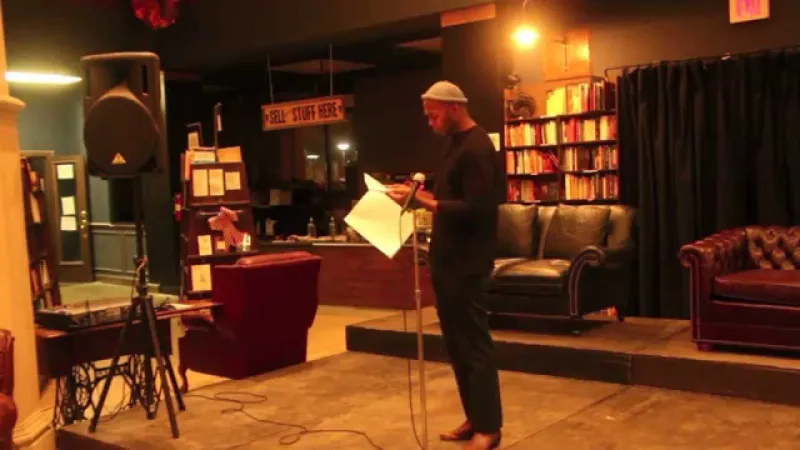
Photo: poet reading aloud at microphone in small bookstore event, via i.ytimg.com
The first poetry reading I ever gave drew an audience of four: two friends, one stranger, and a large elderly dog named Biscuit who fell asleep before my second poem and did not wake until the Q&A, at which point he snored audibly. I have since read in a library meeting room that smelled faintly of laminating film, in a bookstore wedged between the cookbooks and the astrology section, and in a backyard in Louisiana where a wind chime kept its own percussion section. I have learned more about poems — mine and everyone else's — from these rooms than from any workshop.
Here is what I wish someone had told me before my first microphone.
The Microphone Is Not Your Friend Yet
Poets are, as a species, not equipment people. We will spend seven years on a line break and then approach a microphone the way one approaches a sleeping wasp. Learn the basics anyway. Arrive early. Test the mic at the height you will actually use it. If there is a podium, decide in advance whether you want it — many of us hide behind podiums, and hiding reads as stiffness from the back row. If the sound system hisses, ask if you can simply project; most small venues will say yes, and your poems were written to be spoken by a human voice, not amplified into a tin can.
And rehearse standing up. Poems read seated at your desk have a rhythm; poems read standing in a room have a different one. Your body has to learn the difference before the night of.
Build the Set List Like a Set, Not a List
New readers almost always open with their best poem and then wonder why the room deflates. Think of the reading as an arc. Open with something welcoming — not your weakest work, but something that lets the audience settle. Save the poem that means the most to you for two-thirds of the way through, when the room knows you well enough to receive it. Close strong, but close; the audience's gratitude curdles into endurance around the forty-five minute mark, and no poem survives endurance.
A practical rule I stole from a jazz musician: always have one more poem ready than you plan to read, and one fewer than you want to read.
The Four-Person Audience Is Still an Audience
Every poet has a sparse-room story. Mine involves that dog, that backyard, and a poem about my grandmother delivered to three humans and one snoring retriever. What I learned: the four people who came chose to come. They could have been anywhere. Reading with full energy for four people is not embarrassing; it is the whole job. Word travels. The stranger at the four-person reading in 2011 is, I am not making this up, a friend and a steady attender of everything I do within driving distance.
Also: lower your expectations about applause timing. In a small room, silence after a poem is often attention, not rejection. Do not rush to fill it.
Practicalities Worth Their Weight
A short checklist, hard-won:
- Bring water. Readings are drier than anyone expects.
- Bring a physical copy of your poems, printed in large type, even if you plan to read from the book. Books fall open to the wrong page. Pages stick. Have a backup.
- Decide in advance how you will introduce poems — one sentence of context, no more. The poem should carry the rest.
- If you read a poem about something raw, know that someone may cry, and that this is success, not failure. Do not apologize to them.
- Thank the bookseller, the librarian, the host. They run on gratitude and not much else.
Why Any of This Still Matters
I know the objection. Poems live on screens now; a reading can be recorded, posted, clipped, scrolled past. Why stand in a room?
Because the room is the point. A poem on a phone is a private transaction between one voice and one eye. A poem read aloud in a library meeting room happens in shared time, among breathing people, with no algorithm deciding what comes next. I have watched a room full of strangers go still at the same line, and there is no digital equivalent of that stillness. Instagram can show you a poem; it cannot make you sit in a folding chair and feel forty other people feel it with you.
The reading circuit is unglamorous. It is mic stands and folding chairs and a dog named Biscuit. It is also, still, the oldest technology poets have: one voice, a room, and the stubborn belief that language said aloud to other people is worth the drive.